

Key Points
- The U.S. stock market recovered from the lows experienced in April and has regained ground, reaching all-time highs.
- We expect market volatility to remain elevated for at least the remainder of this year.
- Our team will be looking to rebalance portfolios more frequently by maintaining tighter boundaries around target stock and bond allocations.
If you have only recently reviewed your investment portfolio, you may not have realized the stock market’s dramatic fluctuations this year. The S&P 500 Index (U.S. Large Cap Stocks) reached an all-time high on February 19, only to experience an almost 20% drop shortly thereafter. Despite this rapid sell-off, as of this writing, the market has recovered quickly, returning to all-time highs.
2025 Market Outlook
In previous updates, we noted that the stock and bond markets conveyed different narratives during the sell-off. Stock market volatility spiked to levels not seen outside extreme panics like the Great Financial Crisis (2008) and the 2020 COVID-19 Pandemic. 1
Although there was apparent weakness, we did not see the same level of panic when examining the bond market, particularly the riskier segments of lower-credit-quality bonds.
At the time of the updates, we aligned more with the bond market’s economic outlook than the stock market’s. Specifically, while acknowledging that risk and uncertainty had increased since Liberation Day (April 2, 2025), it was not a foregone conclusion that the U.S. economy was heading into a recession. So far, it appears that the bond market has accurately forecasted the economic implications of the uncertainty surrounding tariff policy.
Our base-case scenario remains that the U.S. economy will not enter a recession in 2025. When we look beyond tariff uncertainty, we see potential GDP growth drivers that are likely to continue into year-end, including:
- Lower energy prices
- Slowing U.S. inflation data
- Potential Federal Reserve rate cut(s)
- A possible boost to Capex spending (One Big Beautiful Bill Act)
We recognize that the probability of different economic outcomes, such as a recession, is not trivial. This means that despite our team’s expectation of continued growth in the U.S. stock market, we must prepare client portfolios for heightened volatility, at least through the remainder of this year. This perspective of extended volatility is not currently reflected in financial market prices.
Derivatives Market
The U.S. derivatives market (based on notional value) is a significant area of the financial markets, larger than the market capitalization of the U.S. stock market. The derivatives market gained popularity in the late 1980s, with the options market being one of its most important components. An option is a contract deriving its value from an underlying asset, such as stocks, bonds or commodities.
Option contracts linked to the S&P 500 Index are among the most frequently traded in the global derivatives market. One interesting aspect of the options market is that the price of a derivatives contract can inform investors about expected future stock market volatility. Although volatility expectations are constantly changing and often unstable, we track this data to understand how much volatility is being priced into the market.
Examining the Volatility Data
The graph below shows that expected stock market volatility (blue line) has decreased over the past few months, despite actual stock market volatility (orange line) remaining elevated. This suggests that, at an aggregate level, option investors anticipate lower stock market volatility in the next three months compared to the previous three months.
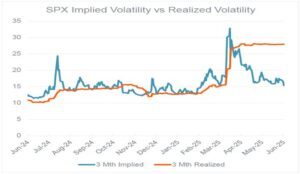
The current VIX Index (Fear Index) level supports this theme, indicating that expected volatility will be lower. Historically, the median level for the VIX Index is around 20. With the current reading at 16, the options market is not anticipating a spike in market volatility soon.
While we agree with option investors that volatility risk has decreased since the March and April sell-off, we disagree with the assessment that a low-volatility environment is forthcoming. From our perspective, significant uncertainty remains regarding geopolitical risks, U.S. federal deficit concerns, elevated inflation levels and tariff policy outcomes.
As stated at the beginning of this blog, our base case is that the U.S. stock market will continue to grind higher for the remainder of the year. However, it is crucial to account for the possibility that volatility will remain elevated.
What This Means for You
Rebalancing client portfolios back to their original stock/bond targets is a prudent risk management tool in this environment where we expect positive stock market performance but elevated volatility. As confirmed in the seminal 1988 paper, “Dynamic Strategies for Asset Allocation,” portfolio managers should consider a rebalancing strategy to help determine the actions needed when client portfolio allocations and asset prices fluctuate.2
If we are correct in stating that volatility will remain elevated, we can implement tighter boundaries for rebalancing portfolios to manage risk.
For example, if the stock market continues to rise and a portfolio’s stock allocation shifts from its 50% target to 55% due to gains, the portfolio would be rebalanced back to its 50% target by selling stocks and purchasing bonds. Applying a tighter boundary might involve beginning the rebalance process when the stock allocation reaches 53% instead of 55%.
1 As measured by the Intra-day VIX Index.
2 Perold, A. F., & Sharpe, W. F. (1988). Dynamic Strategies for Asset Allocation. Financial Analysts Journal, 44(1), 16–27. https://doi.org/10.2469/faj.v44.n1.16
Disclosure
Past performance does not guarantee future results. Diversification does not guarantee investment returns and does not eliminate the risk of loss. Opinions and estimates offered constitute our judgment and are subject to change without notice, as are statements of financial market trends, which are based on current market conditions. We believe the information provided here is reliable, but do not warrant its accuracy or completeness. The views and strategies described may not be appropriate for all investors. This material should not be relied on for, accounting, legal or tax advice. Any forecasts contained herein are for illustrative purposes only and are not to be relied upon as advice or interpreted as a recommendation. This document is a general communication being provided for informational purposes only. It is educational in nature and not designed to be taken as advice or a recommendation for any specific investment product, strategy, plan feature or other purpose. This material does not contain sufficient information to support an investment decision and it should not be relied upon by you in evaluating the merits of investing in any securities or products. Investors should ensure that they obtain all available relevant information before making any investment. Any forecasts, figures, opinions or investment techniques and strategies set out are for information purposes only, based on certain assumptions and current market conditions and are subject to change without prior notice. Investing involves risks, the value of investments and the income from them may fluctuate in accordance with market conditions and taxation agreements and investors may not get back the full amount invested. Both past performance and yields are not reliable indicators of current and future results.
Investment advisory services offered through RKL Wealth Management LLC. Consulting and tax services offered through RKL LLP. RKL Wealth Management LLC is a subsidiary of RKL LLP.


