
In the sixth article in our Form 990-T blog series, our advisors explain the rules tax-exempt organizations must follow when engaging in political activities and lobbying. Learn what constitutes prohibited political campaign intervention, how lobbying limits apply to different types of exempt organizations, and what safeguards can help prevent excise taxes or the loss of tax-exempt status.
Read the fifth blog to learn how pass-through income can trigger UBIT and Form 990-T filing requirements.
Tax-exempt organizations of all types face stringent regulations and scrutiny regarding political activities, such as lobbying and electioneering, under the Internal Revenue Code. Failure to meet these restrictions and rules can result in harsh punishment, including the loss of exempt status, thus making compliance vital. By identifying what constitutes political support and which activities are permissible, organizations can establish guidelines and safeguards to prevent violations.
What Is Considered Political Support?
Reg. § 1.501(c)(3)-1(b)(3) defines political activity as participating or intervening, directly or indirectly, in any political campaign on behalf of or in opposition to any candidate for public office. These include candidates for national, state or local public offices.
Actions that are considered political support include, but are not limited to, the following:
- Contributions to political campaign funds on behalf of the organization
- Public statements in support of or in opposition to a candidate or a political party, whether written or oral
- This includes speeches, mail, email, text, or posting on social media or the Internet
- Utilization of the organization’s resources, like office space, social media, printers, and employee time to engage in political campaign activity
- Conducting biased voter education or registration activities favoring one candidate or group of candidates over another
- Making or soliciting contributions for, on behalf of, or against any candidate for public office or to a political party
- Providing funds to a 501(c)(4) organization without ensuring that the funds are used solely for 501(c)(3)-exempt purposes and not for political campaign activity
Organizations have unexpectedly lost their exempt status for involvement in school board, water commission and other local campaigns due to a lack of understanding of the extensive scope of the definition of political support.
Regulations on Lobbying
Lobbying is defined as communication with members or employees of a legislative body in support of, in opposition to, or to propose legislation. Legislation can vary from an action by Congress, any state legislature, any local council, or similar governing body, with respect to acts, bills, resolutions, or similar items (such as legislative confirmation of appointive office), or by the public referendum, ballot initiative, constitutional amendment, or similar procedure. Engaging in nonpartisan analysis, study, or research and making its results available to the general public or a segment of members thereof, or to governmental bodies, officials, or employees, isn’t considered lobbying.
Can 501(c)(3) Organizations Engage in Lobbying?
A 501(c)(3) public charity is permitted to engage in lobbying and grassroots expenditures to an extent. The Internal Revenue Code has created an “expenditure test” and a “substantial part test” to provide limits on lobbying activities conducted by 501(c)(3) public charities. If a 501(c)(3) organization claims a 510(h) election through filing Form 5768, the organization would utilize the expenditure test.
Which 501(c)(3) Organizations Face Different Rules?
Private foundations, churches, and integrated auxiliaries of churches are not permitted to file the 501(h) election. 501(c)(3) private foundations cannot engage in any legislative lobbying at all.
501(c)(3) Lobbying Compliance Regulations
When a 501(c)(3) organization engages in direct or indirect political campaign activities or lobbying, the organization is responsible for reporting related information on a Schedule C on the Form 990.
Expenditure Test
The extent of an organization’s lobbying activity will not jeopardize its tax-exempt status, provided its expenditures related to such activity do not normally exceed an amount specified in section 4911. This limit is generally based upon the size of the organization and may not exceed $1,000,000, as indicated in the table below.
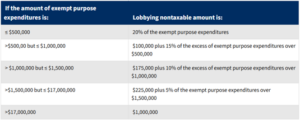
Under the expenditure test, an organization that engages in excessive lobbying activity over four years may lose its tax-exempt status, making all of its income for that period subject to tax. Should the organization exceed its lobbying expenditure dollar limit in a particular year, it must pay an excise tax equal to 25% of the excess.
Substantial Part Test
Under the substantial part test, an organization that engages in excessive lobbying in any taxable year may lose its tax-exempt status, resulting in all of its income becoming subject to tax. In addition, section 501(c)(3) organizations that lose their tax-exempt status due to excessive lobbying, other than churches and private foundations, are subject to an excise tax equal to 5% of their lobbying expenditures for the year in which they cease to qualify for exemption.
What Is a PAC?
A political action committee (PAC) is an organization that raises and spends funds to support or oppose candidates for public office. PACs are generally subject to federal and state campaign finance laws, including registration, reporting, and contribution limitations.
Limitations on Political Activities Placed on Various Tax-Exempt Organizations
Not all tax-exempt entities are subject to the same restrictions. The chart below compares the political activities and PAC-related involvement that may be permissible under federal law for various types of tax-exempt organizations:

What Are the Consequences of Engaging in Political Support?
When an organization is deemed to have violated this prohibition, its tax-exempt status may be denied or revoked in addition to the imposition of excise taxes.
To avoid the loss of its exempt status, an organization may be able to correct political expenditures by recovering the money to the extent possible and adopting safeguards to prevent future political expenditures. If the violation is due to reasonable cause and not from willful neglect, the tax may be abated. A first-tier excise tax of at least 10% and up to 100% is imposed on political campaign expenditures, in addition to a 2.5% tax (capped at $5,000 per expenditure) on the organizations’ managers involved in the activity.
How to Prevent Political Expenditures
Officers, directors and employees of tax-exempt organizations may engage in campaign activities if they do so in their individual capacity and do not use any of the organization’s resources to support the activity. Inform staff of the prohibited and permissible activities in the employee manual or other training materials to ensure compliance.
It is recommended to avoid having candidates involved with the organization to minimize risks and maintain a nonpartisan position. If candidates are to speak at functions for a tax-exempt organization, their message should pertain only to the charitable organization and its mission.
Proactive guidance can help tax-exempt organizations understand political activity and lobbying restrictions, establish appropriate safeguards, and protect their exempt status. Contact RKL’s expert nonprofit tax advisors for help navigating these complex compliance requirements.