

Key Points
- The U.S. economy remains somewhat “bifurcated,” with higher-income households driving most consumer spending. Key indicators like the Purchasing Managers’ Index (PMI) suggest broadening economic growth.
- Mid- and small-cap stocks have outperformed large caps so far this year. Large-cap tech stocks (“Magnificent Seven”) are facing challenges, partly due to concerns about artificial intelligence.
- Broader economic growth could benefit both lower-income households and mid-/small-cap stocks.
Market Update
Financial markets are off to a strong start this year, with global stock markets continuing their upward trends. International markets have sustained their robust performance from 2025, aided by a weakening USD. For U.S. investors, a weaker USD means more dollars are required to purchase foreign currency, which can enhance returns on international holdings when translated back to USD.
Global Performance
Japan’s Nikkei Index, included in most developed international stock market indices, is up over 12% year-to-date (YTD) and over 14% YTD when adjusted for currency translation effects. Emerging markets are also performing strongly, with major indices in Taiwan and South Korea up double digits. Notably, the Korea Stock Exchange Index (KOSPI) has returned over 30% YTD.
U.S. Stock Market
Domestically, stock markets have advanced, with performance concentrated in small- and mid-cap stocks. Both U.S. Mid Cap and Small Cap indices are up more than 7% YTD, whereas U.S. Large Cap stocks—which previously benefited from a decade-long bull market—have posted relatively lackluster results. Media coverage has recently highlighted concerns about artificial intelligence, which has pressured performance among the so-called “Magnificent Seven” tech giants (Nvidia, Meta, Alphabet, Microsoft, Amazon, Apple and Tesla).
Interest Rates and Inflation
U.S. interest rates have continued to trend lower, supporting performance across all bond asset classes. Since September of 2024, the Federal Reserve has continued to lower its short-term interest rate target from a peak of 5.5% to the current level of 3.75%. Despite U.S. inflation (as measured by CPI) remaining above the long-term target of 2%, inflation data has declined from the peak seen in 2022.
Potential New Stock Market Trends
Recent years have seen a bifurcation in the U.S. economy, with higher-income households (above $100,000) historically accounting for over 60% of consumer spending—a key component in GDP calculations. This has led to what media outlets describe as a “K-shaped” economy: the wealthy see continued improvements, while lower-income households face ongoing inflationary pressures.
This economic divergence has also affected financial markets, with U.S. large-cap stocks consistently outperforming mid- and small-cap stocks. However, at RKL’s Annual Update, it was noted that potential economic tailwinds could broaden growth in 2026, benefitting a wider array of market participants (“all ships rising” rather than just the “Magnificent Seven”).
Early Indicators
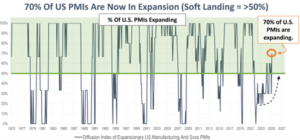
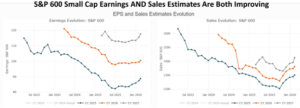
High-frequency economic data, such as the U.S. PMI, suggest a possible broadening of the economic recovery. The PMI has remained above the 50% expansion threshold, indicating increasing customer demand and a positive outlook for broader growth. As the PMI has improved, earnings projections for smaller companies (as reflected by positive revisions in the S&P 600 Index for small-cap stocks) have also increased since late 2025 and into 2026.
Investor Implications
If current inflection points in economic data develop into lasting trends, it would support the forecast that a U.S. recession is not imminent. An expanding economic backdrop may also benefit lower-income households, potentially reducing economic bifurcation.
- Potential for continued performance: Should broader economic growth persist in 2026, U.S. mid- and small-cap stocks may continue to outperform.
- Risk management: A more inclusive economic recovery would likely reduce the probability of a near-term recession.
RKL’s Private Wealth experts are available to help you navigate the complexities the market present. Now is the perfect time to meet with your advisor to review your portfolio.
If you would like to receive this information and more insights in your inbox, subscribe to our monthly Insights in What’s Next newsletter.
Disclosure
Past performance does not guarantee future results. Diversification does not guarantee investment returns and does not eliminate the risk of loss. Opinions and estimates offered constitute our judgment and are subject to change without notice, as are statements of financial market trends, which are based on current market conditions. We believe the information provided here is reliable, but do not warrant its accuracy or completeness. The views and strategies described may not be appropriate for all investors. This material should not be relied on for, accounting, legal or tax advice. Any forecasts contained herein are for illustrative purposes only and are not to be relied upon as advice or interpreted as a recommendation. This document is a general communication being provided for informational purposes only. It is educational in nature and not designed to be taken as advice or a recommendation for any specific investment product, strategy, plan feature or other purpose. This material does not contain sufficient information to support an investment decision and it should not be relied upon by you in evaluating the merits of investing in any securities or products. Investors should ensure that they obtain all available relevant information before making any investment. Any forecasts, figures, opinions or investment techniques and strategies set out are for information purposes only, based on certain assumptions and current market conditions and are subject to change without prior notice. Investing involves risks, the value of investments and the income from them may fluctuate in accordance with market conditions and taxation agreements and investors may not get back the full amount invested. Both past performance and yields are not reliable indicators of current and future results.
Investment advisory services offered through RKL Wealth Management LLC. Consulting and tax services offered through RKL LLP. RKL Wealth Management LLC is a subsidiary of RKL LLP.