

If you have been watching the markets lately, the rebound has been hard to miss. Equity markets recovered quickly in April, and many sectors moved higher simultaneously. Large-cap U.S. stocks posted gains, International Developed Markets advanced and Emerging Markets performed even better.
The broad participation is notable and suggests the market recovery has expanded beyond just a handful of large companies. It also reflects a more constructive tone across risk assets, even as uncertainty remains in the background.
At the same time, strong returns do not always mean risk has disappeared. When you look beneath the surface, volatility, oil prices, and interest rate expectations are telling a more nuanced story.
Equity Markets Have Recovered Quickly
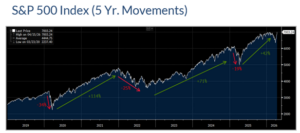
One of the clearest takeaways from recent market activity is how quickly stocks have bounced back. After falling by roughly 10% from peak to trough, the S&P 500 staged another sharp V-shaped recovery and moved back to within about 1% of all-time highs. This rebound speaks to the resilience of equity markets, particularly in an environment where investors are still weighing inflation, interest rates, and global uncertainty.
The recovery has also become broader. For much of the last several years, large-cap stocks led the market while smaller companies lagged. More recently, small-cap stocks have started to gain traction, and International Developed and Emerging Markets have also performed well. This broader participation can be viewed as a positive sign because it suggests that market strength is not limited to a single, narrow segment of the equity market.
Low Volatility Suggests Markets Are Not Pricing in Much Fear
As strong as the market recovery has been, one question remains important: Are investors pricing in enough risk?
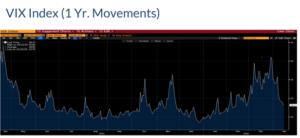
One way to evaluate the level of risk perceived in the market is through the VIX index, often referred to as the market’s “fear index”. In general, when the VIX rises, stock prices tend to fall. When the VIX moves lower, it usually suggests investors are becoming more comfortable with near-term market conditions.
Right now, the VIX has dropped sharply and sits below historical median levels, suggesting the equity market is not pricing in much fear, even though uncertainty has not gone away. In practical terms, the market appears relatively calm, and investors are not paying up for much downside protection. That does not automatically mean volatility is about to return, but it does suggest markets may be underestimating how quickly sentiment can shift.
Oil Markets Are Sending a Different Signal
While U.S. equity markets appear relatively calm, oil markets have offered somewhat of a different perspective. Oil prices have moved down from their recent highs, which is a positive development. Lower oil prices can help ease pressure on inflation and support a more stable market environment. At the same time, oil remains above its longer-term average, suggesting some risk is still being priced into energy markets.
This is an important contrast. If equity markets are signaling confidence while oil still reflects some uncertainty, it may mean different parts of the market are interpreting current conditions differently. That disconnect may not persist, but it is worth watching.
The current direction in oil prices is encouraging. Even so, markets do not appear to be assuming that uncertainty will disappear immediately, so oil remains a useful indicator when evaluating broader market risk.
Two Charts That Help Explain the Current Market Story
- The S&P 500 recovery chart
The first chart is the recent path of the S&P 500. Over the last five years, markets have experienced several sharp declines followed by equally sharp recoveries. The latest rebound fits that pattern.
This matters because it reinforces how quickly markets have been willing to move past short-term shocks. Even after a meaningful pullback, investors quickly returned to risk assets, pushing large-cap stocks back near record levels.
- The VIX and volatility term structure
The second chart is the recent path of the VIX and the broader pricing of volatility over time. Earlier in the year, when markets were more unsettled, near-term volatility was priced higher than longer-dated volatility. That is typically what happens when investors are concerned about immediate risk.
Now, the structure has returned to a more normal pattern, where current volatility is lower and expected to rise modestly over time. This dynamic is often referred to as contango. For investors, the takeaway is straightforward: the market is no longer pricing in near-term panic. While a constructive signal, it can also leave less room for error if conditions change.
Interest Rates and Inflation Expectations Still Matter
While the market has focused heavily on equities and oil, interest rates remain one of the most important drivers of what comes next. Inflation expectations in the intermediate term remain relatively anchored near the Federal Reserve’s target, which is encouraging because it suggests investors are not expecting inflation to move significantly higher over the long run.
However, expectations for interest rate cuts have changed. Earlier in the year, markets expected multiple rate cuts before year-end. That outlook has shifted, and now the market appears to be pricing in a flatter path for rates. In other words, investors increasingly expect the Fed to remain cautious and hold rates steady for longer. This shift in expectations matters because it affects both market sentiment and portfolio positioning.
What This Could Mean for Client Portfolios
For client portfolios, the current environment does not necessarily call for dramatic changes, but it does support thoughtful adjustments. One area of focus is duration within fixed-income portfolios. With interest rates still elevated and the timing of rate cuts pushed further out, there may be an opportunity to bring duration closer to benchmark and lock in higher yields than were available earlier in the cycle. The broader message is that portfolio positioning should stay disciplined.
Recent market action has included several positive developments:
- Equity markets have recovered quickly.
- Small-cap and international stocks have shown renewed strength.
- Volatility has declined.
- Oil prices have come off their highs.
- Inflation expectations remain relatively anchored.
This does not necessarily mean volatility is behind us. If uncertainty persists, oil prices rise again, or inflation proves more stubborn than expected, market volatility could return. That is why diversification and long-term discipline remain important, even during periods of market strength.
Why a Balanced View Still Matters
Right now, markets are sending mixed but manageable signals. On one hand, the recovery in equities has been strong, broad, and encouraging. On the other hand, low volatility and elevated oil prices suggest that some risks may not be fully reflected in current market pricing.
If you are evaluating the market environment today, it may be helpful to look beyond headline returns and focus on the forces shaping them underneath the surface. Volatility, oil, inflation expectations, and interest rate policy all remain important to watch.
If you have questions about how current market conditions may affect your financial plan or client portfolio, reach out to your RKL advisor. Your advisor or investment team portfolio manager can help you understand how these trends fit into your broader strategy.
Disclosure
Past performance does not guarantee future results. Diversification does not guarantee investment returns and does not eliminate the risk of loss. Opinions and estimates offered constitute our judgment and are subject to change without notice, as are statements of financial market trends, which are based on current market conditions. We believe the information provided here is reliable, but do not warrant its accuracy or completeness. The views and strategies described may not be appropriate for all investors. This material should not be relied on for, accounting, legal or tax advice. Any forecasts contained herein are for illustrative purposes only and are not to be relied upon as advice or interpreted as a recommendation. This document is a general communication being provided for informational purposes only. It is educational in nature and not designed to be taken as advice or a recommendation for any specific investment product, strategy, plan feature or other purpose. This material does not contain sufficient information to support an investment decision and it should not be relied upon by you in evaluating the merits of investing in any securities or products. Investors should ensure that they obtain all available relevant information before making any investment. Any forecasts, figures, opinions or investment techniques and strategies set out are for information purposes only, based on certain assumptions and current market conditions and are subject to change without prior notice. Investing involves risks, the value of investments and the income from them may fluctuate in accordance with market conditions and taxation agreements and investors may not get back the full amount invested. Both past performance and yields are not reliable indicators of current and future results.
Investment advisory services offered through RKL Wealth Management LLC. Consulting and tax services offered through RKL LLP. RKL Wealth Management LLC is a subsidiary of RKL LLP.